After a late spring the vegetables are quickly catching up to a more normal schedule. Except for the eggplant which should have been seeded a week earlier, all of the warm weather plants are in and doing well.
This week I picked the first of the spring planted cole crops, a Kolibri kohlrabi. More should be coming in soon. I sliced it up into french fry strips and sauteed it briefly. It's a pity that more people don't know about kohlrabi, if they grew it once I'm sure it would be part of a regular planting. It's easy to grow, matures quickly, and is mild and buttery. The beer bottle in the picture is there for size comparison.
Of course there's the usual lettuce and spinach which has been producing for weeks, always the first of the vegetables that I get here in southwestern Indiana. This is the first lettuce that came out of the raised beds. Prior to this picking I harvested about 4 pounds of lettuce from the Earthbox, a pretty good haul in my opinion.
The potato box experiment is in progress. I planted two Red Pontiac seed potatoes in the box, and the shoots were up about 3-4 inches. Yesterday I covered about 2/3 of the foliage with some half finished compost, leaving the front shoots uncovered. When they get a little longer I will attach the next pieces of carsiding and direct the shoots out through holes cut in the boards.
For the week I picked: spinach 6 oz, lettuce 17 oz, kohlrabi 8 oz.
Mike's Bean Patch
Growing vegetables in raised beds. Wildlife habitat. Building things. Location: SW Indiana.
Monday, May 20, 2013
Tuesday, May 14, 2013
Planting day
Whether planting seeds or seedlings in the beds, I think of starting vegetables as work in progress. Something is always going in or going out. Spent plants are pulled up and replaced. In these parts most people with a garden plant everything sometime before Memorial Day (fair weather gardeners). I've been planting sets of cabbage family seedlings every 12 days since sometime in March. But it turns out there is one day each May when more plants get started in the beds than any other day. That day was today.
Why today? On Monday morning the area had it's last predicted brush with a frost. Actually it wasn't even close. Now it's warm, in fact 82 degrees F as I write this. It was time for the warm weather plants to go into the ground. I have been setting the tomatoes and peppers outdoors each day for several days to get them ready.
This year I'm planting three tomato plants instead of two - Supersonic, which I plant every year, Cherokee Purple, and San Marzano, a sauce tomato. I plan to can some salsa. This is my caging method. First I set three cages on the ground to mark their location. I found that pushing the cages into a somewhat oval shape allowed them all to fit into a triangle in the bed. I drove 7 foot fence posts at the outside mark of the back cages then hung the cages on the hooks in the post (it so happens that the post hooks are the same distance apart as the mesh in the rebar cages). The cages are held on the posts with the bottom of the cage about 20 inches above the soil level.
The tomato plants were more than ready to be set out. The nurseries and greenhouses around here always start their plants too early. I bought them two weeks ago and repotted them to larger pots. The same with the peppers. The suspended cages leave plenty of room to set in the tomato plants. The two red cups mark the location for the eggplants which are not big enough to go out yet. The peppers are: Ancho, Holy Mole, Jalapeno, Lipstick (similar to Carmen), Cabernet (a Burpee's purple sweet pepper which is a cross between Marconi and something else), and Corro di Torro Rossa, which is a bullhorn type sweet pepper. I was planning to put two okra plants in the unused space at the end but will put something else there. The plant at the front is a small Greek basil.
Millionaire okra was planted in the two self-watering containers that I built early this spring. Guess I'll find out if the design worked or not. The Earthbox grew several pounds of great lettuce. It's all out now and replaced with celery seedlings. Maybe this is the year I actually get some celery out of the garden.
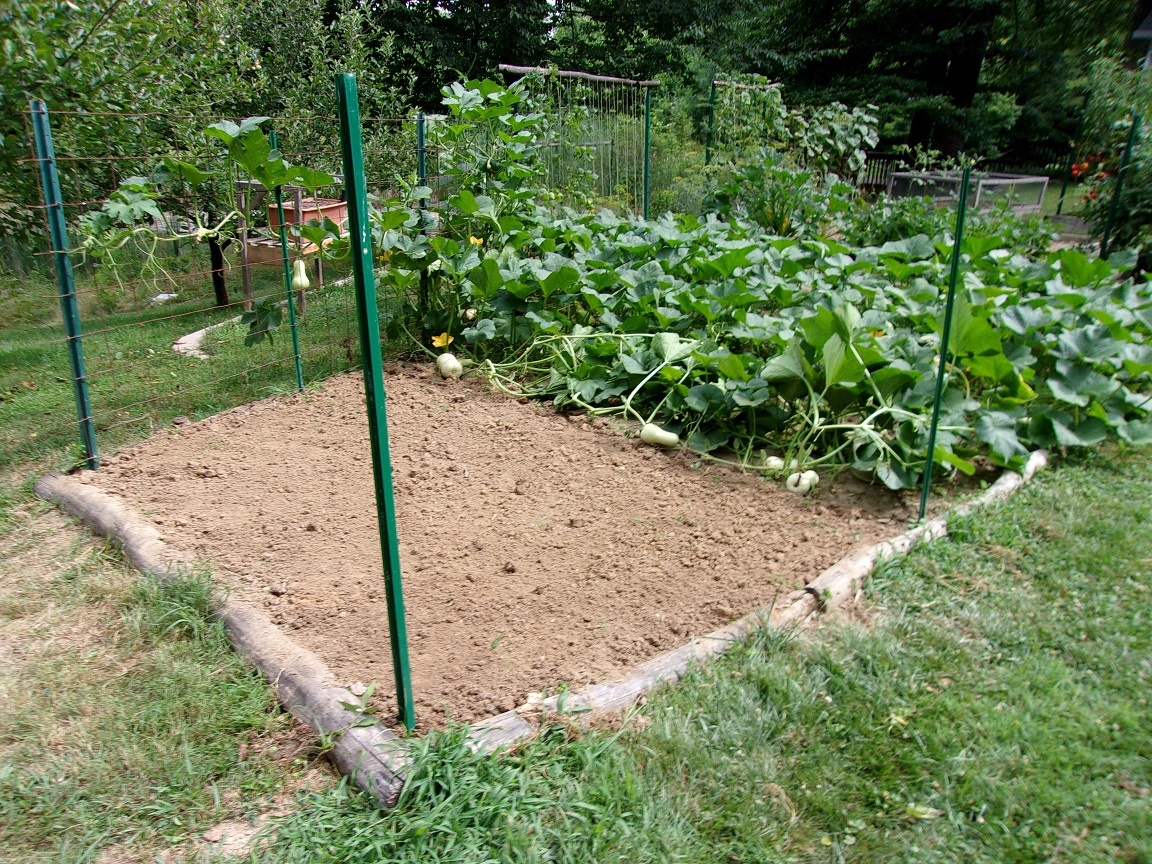
Two eight foot lengths of rebar trellis were set up behind the terraced bed on the slope toward the pond. There's a lot of compost in this bed. I got lucky and found someone with a supply of well composted horse manure and straw which went into the remaining unplanted beds. I planted half of this bed in Metro Butternut, a Johnny's variety that has always worked well here, and the other half in Teksukabotu, an Asian hybrid that is part C. moschata so it should be resistant to the borer.
As for the rest of the garden, the cole crops are coming along well. I expect to pick some kohlrabi any day now.
And the greens bed has been steadily producing spinach. The lettuce is almost ready but I've got several pounds in the refrigerator. There's also some cole crops in the greens bed that were the first plants set out, but they got a shiver in the late cold and are miniatures.
I left space on the north side of this bed for cucumber plants, two Diva plants and two Picolino plants. They also went in today. I still have to set up the trellis but could not find the ambition to do that today. The open space at the front was planted with Provider beans.
Last but not least the trapezoidal bed was seeded with a yellow zucchini and Honey Bear acorn squash. One corner was planted with two Silver Queen okra seedlings. Well not quite last as I almost forgot. Two of the more decomposed modules from the compost bin were set on the slope toward the pond and filled with soil and compost. The sweet potato slips will go here.
Why today? On Monday morning the area had it's last predicted brush with a frost. Actually it wasn't even close. Now it's warm, in fact 82 degrees F as I write this. It was time for the warm weather plants to go into the ground. I have been setting the tomatoes and peppers outdoors each day for several days to get them ready.
This year I'm planting three tomato plants instead of two - Supersonic, which I plant every year, Cherokee Purple, and San Marzano, a sauce tomato. I plan to can some salsa. This is my caging method. First I set three cages on the ground to mark their location. I found that pushing the cages into a somewhat oval shape allowed them all to fit into a triangle in the bed. I drove 7 foot fence posts at the outside mark of the back cages then hung the cages on the hooks in the post (it so happens that the post hooks are the same distance apart as the mesh in the rebar cages). The cages are held on the posts with the bottom of the cage about 20 inches above the soil level.
I suspend the cages this way in order to get the maximum height possible. Six feet is nothing for a healthy tomato plant. I made sure the horizontal wires of the cages matched exactly since they will be wired together later. The bottom hooks of the post face down and the bottom wire of the cage was pulled down and over that hook, which takes either very strong hands or a good pair of pliers. Once hooked this way the cage is attached quite securely to the post.
Then I marked the outside of the front cage and set in two more posts. The front cage was suspended on those posts in the same fashion. Once all the cages were in place I wired them together. With only four posts for three cages the finished structure is actually very solid. It was time to set in the tomatoes.
Millionaire okra was planted in the two self-watering containers that I built early this spring. Guess I'll find out if the design worked or not. The Earthbox grew several pounds of great lettuce. It's all out now and replaced with celery seedlings. Maybe this is the year I actually get some celery out of the garden.
Two eight foot lengths of rebar trellis were set up behind the terraced bed on the slope toward the pond. There's a lot of compost in this bed. I got lucky and found someone with a supply of well composted horse manure and straw which went into the remaining unplanted beds. I planted half of this bed in Metro Butternut, a Johnny's variety that has always worked well here, and the other half in Teksukabotu, an Asian hybrid that is part C. moschata so it should be resistant to the borer.
As for the rest of the garden, the cole crops are coming along well. I expect to pick some kohlrabi any day now.
And the greens bed has been steadily producing spinach. The lettuce is almost ready but I've got several pounds in the refrigerator. There's also some cole crops in the greens bed that were the first plants set out, but they got a shiver in the late cold and are miniatures.
I left space on the north side of this bed for cucumber plants, two Diva plants and two Picolino plants. They also went in today. I still have to set up the trellis but could not find the ambition to do that today. The open space at the front was planted with Provider beans.
Last but not least the trapezoidal bed was seeded with a yellow zucchini and Honey Bear acorn squash. One corner was planted with two Silver Queen okra seedlings. Well not quite last as I almost forgot. Two of the more decomposed modules from the compost bin were set on the slope toward the pond and filled with soil and compost. The sweet potato slips will go here.
Monday, May 6, 2013
Monday May 6
I harvested spinach (5 oz) and lettuce (17 oz) this week –
the same two leafy vegetables I’ve been getting for about a month. It won’t be long before the cole crops are
ready, first kohlrabi then cabbage and broccoli. There's about one more pound of lettuce to get from the Earthbox, then in go the celery seedlings. I'm finding that the Earthbox grows some really nice lettuce.
With the 10 day forecast looking promising I’ll seed a small patch of Provider green beans tomorrow. This week I’ll start preparing the solanacae bed for the tomatoes, peppers and eggplants. Those seedlings as well as okra and cucumber are growing under the lights right now.
The gash in the levee from the recent hard rain has been repaired. First the large wild rose bushes were cut down. I got tangled up in the thorns a few times trying to crawl underneath the thorny canopy to reach the trunks with the chainsaw - working on a steep bank no less. Since the rose canopy was a large ball of vines the best I could do was push the entire ball of foliage down the slope of the bank with a rake. I realize now that the overgrown rose bushes were the problem. They only anchor the soil around their trunks and the canopy is so dense that nothing else grows underneath, leaving areas of soil with no root system to anchor it.
Once the rose bushes were out of the way I set concrete
blocks into the gash, making several levels of crude retaining walls to help
hold the new dirt in place. Then it was
time to add dirt. The dirt was loaded
into the cart, pulled with the garden tractor to the levee and then shoveled
into the gash. It took 8 yards of dirt
to fill the gash and make a smooth slope. This picture shows the first blocks put into the gash. About 20 more blocks were added.
By Wednesday all the dirt was in place. Since the dirt was delivered dry (much
lighter than wet) it needed wetting. To
reach the repair with water I ran 125 feet of extension cords toward the levee,
set up the pump and attached 130 feet of hose which just reached the far end of
the repair. That’s when I found that
the dry soil would not absorb water very much water without forming rivulets of
water that would eventually form channels.
I lightly watered the soil once an hour for the remainder of the day and
several more times the following morning.
It’s been raining nearly all weekend. Fortunately it has been a very slow rain and it looks like the repair has held together. I think an intense downpour would have washed much of it away again, so a bullet has been dodged. There’s still some minor repairs to do and the remaining dirt will be put on top of the levee to raise up a low place in the embankment. I hope that I never have to do this ever again.
Subscribe to:
Posts (Atom)