Thursday was an absolutely perfect spring day - not a cloud in the sky, a mild breeze, high of 70 F, green everywhere and no bugs. They just don't make them much better than that. It was also a day to get most of the warm weather crops planted or seeded, and that's what I did. Today I'm a little sore. It was a long day.
Brassica bed # 2 was planted with a set of brassicas - Green Magic broccoli, Gonzalez cabbage, Kolibri and Grand Duke kohlrabi, and Snow Crown cauliflower. This bed was also planted with cucumber along the trellis, this year Diva and Calypso. I'm not planting as many Calypso plants as last year, just three. There are still jars of pickles from last year when I was inundated with pickling cukes. This bed was covered with a layer of shredded leaf mold so weeds were not a problem. I put the leaves around the potato plants, raked the bed level and set in the plants.
I also seeded two rows of Provider beans at one end of this bed. There's still room for one last set of cole crops in a few weeks.
On to the 'greenhouse' bed. This bed gets overwintered spinach, now gone. The spinach was a real disappointment this year. There's still a row of spring-planted Reflect spinach which might just head up before hot weather. How about that dill? This is volunteer dill, originally from a Burpee's hybrid dill which is bred for compactness. The first year it volunteered it was long and leggy, now it is incredibly compact and thick. Hybrids never reproduce true. The okra was planted close to the dill because they will be there long after the dill is out.
The triangle has three parsley plants. I'll sow some cilantro in there but want to time it so it's ready for salsa. The other end was seeded with Cocozelle summer squash.
On to the Solanacae bed. The tomatoes were planted on Tuesday. Eight pepper plants went in on Thursday - Serrano, Jalapeno, Ancho, Jimmy Nardello and Mama Mia Giallo. I left volunteer dill where it had enough space from the peppers and tomatoes. The Giallo pepper is my new favorite large sweet pepper, it's really good for grilling. I haven't pulled up the field peas yet, and the eggplant and basil will go in tomorrow.
The winter squash was seeded in the bare spots in the cover crop - one Teksukabotu, four Metro Butternut, and two Gold Nugget. Pole beans - Fortex and Kentucky Blue - were sown under the trellis in the left of the photo.
I'm not so infatuated with the red-winged blackbirds now. They seem to be taking over and presume that this is their place now. When I go outside there's usually a blackbird that sits in a nearby tree and sasses me constantly. Although I haven't been buzzed yet they get really agitated when I go to the pond's edge near the cattails, probably near a nest. They hate snakes, and I find very small decapitated snakes now and again. I found these two yesterday, both about the size of a large earthworm. One is a copperhead, a poisonous snake, and this is the northern end of their range. It's the first one I've seen here.
Growing vegetables in raised beds. Wildlife habitat. Building things. Location: SW Indiana.
Pages
Friday, May 20, 2016
Monday, May 16, 2016
Finally the tomatoes are in the ground
The vegetable garden got off to a slow start this year. The kitchen remodel took priority over everything else until it was back on line. I never planted any snap peas and started about half the cole crops I normally do. No radishes either. I'm still working on the finish carpentry in the kitchen and trying to catch up on the outdoor work. In April it looked like we would have a very early spring, but it has been cool and wet for several weeks and I've held off setting out the hot weather crops.
I have been looking for a spot for container lettuce. It should get sun in the morning and go into shade in the afternoon. It looked like there was no such spot except in the middle of the yard. Yesterday I added another course of pavers to the terrace near the apple trees. Then I realized that this was the spot. The apple trees will shade one end in mid-afternoon - it was 2 PM when I took this photo. It's really perfect for containers. I set the SWC with anise fennel at one end and put some temporary supports under one side - I still have to bring in some soil to level this.
So today I planned to seed the winter squash. First some patches needed to be cleared in the cover crop. The string trimmer worked great at clearing little circles, removing the oats and peas right down to the ground. Then I took a shovel and turned over each cleared patch. The soil broke to the spade very easily - a good sign. Then I read the seed packet from Johnny's: "seeds may rot in wet cold soil." This soil is definitely wet and cold. With more rain expected tonight and tomorrow expected to be very cool, I thought it best to wait a few more days. But it's ready.
Yes it looks a little untamed. This was before the planting patches were turned over. I must be drifting into some form of permaculture, or just adopting a no-till strategy. What I'm certain of is, it's a lot less work.
On to the tomato/pepper/eggplant bed. Peppers and eggplant can wait, but the tomatoes are getting leggy, and they can handle the cool. This bed has a lot of field peas that overwintered and I did not want to remove any more than necessary. First the cages were set up. I wanted to try smaller cages this year but that will have to wait another year. I set up the cages in pairs. I've found that any more than two adjacent cages and the tomatoes don't get enough ventilation, meaning fungal problems.
A 7 foot fence post was driven into the ground and the first cage hung on the post hooks so the bottom is about a foot off the ground. The second cage was set on the ground to locate the second post. Once driven in the second cage was hung on that post, then the two cages were bound together with wire. A 5 foot post was added for more stability. It takes about 15 minutes to set up a pair of cages.
The field peas and dill that was in the way of the tomatoes was removed. The hard part is digging a hole for the seedlings once the cages are up, but it's not too bad. My tomato choices are very mundane: One cage of Big Beef for slicing and three cages of Super San Marzano for sauces. I planted two seedlings per cage.
The rest of the bed will get two eggplants and eight or nine pepper plants. Here's to Solanacae!
In addition to the tomatoes the pole beans were seeded - Fortex and Kentucky Blue. Nearly all of the structure is in place now. Later this week I will plant the okra, peppers, eggplant, and cucumber seedlings. It's all starting to shape up. I'm always worried about having enough dill, but every year literally hundreds of dill seedlings appear at different times. As long as I'm careful to leave some standing between the plants there is enough to make the pickles. Happy gardening.
Friday, May 13, 2016
Planting strategy
It's about time for setting out the hot weather plants - tomatoes, peppers, eggplant, cucumbers and okra. All of these seedlings are either inside under the lights or in the mobile cold frame. I'm waiting. The forecast calls for cool weather over the weekend with lows around 40 F (4 C). That's not in frost territory but cold enough to shock them, and many of these plants don't like getting a chill. There's also been a lot of rain this May and after last night's rain the soil is saturated, to wet to sow the pole beans.
I'm working on the bigger picture here, taking in the use of cover crops and the large amount of good compost available from raising two rabbit litters this year. In past years I have mostly prepared the beds by mixing in some compost and fertilizer in the spring then turning it over with a spade, then hoeing the larger clods, then tilling with a small power cultivator. It was a lot of work, but the soil never seemed to have enough organic material in it to prevent the clay from 'clodding' up.
This year I saw that the beds that were planted in cover crops last year had good tilth. I gave them a light hoeing to remove the weeds, a little fertilizer, then raked them smooth and planted with brassicas, carrots, parsnip and onions. Much easier. That's a trend I'd like to see continue.
Which brings me to the large bed, where the squash, sweet potatoes, and potatoes go. In mid-March I seeded this bed (except for the potato patch) with oats and field peas and covered everything with half-finished compost. Last year I seeded just peas and weeds became a problem. The oat/pea cover is very tight, practically no weeds get through. The cover crop started slow but has made up for lost time. Every morning and evening I take the shears to a patch and feed the clippings to the rabbits. The kits are just over 3 weeks old now.
When the oats were young and tender the rabbits loved them, but now that the oats are older and more woody they aren't too crazy about them. What they really relish are the field peas, which like any legume are higher in protein than the grasses, good for nursing rabbit does and growing kits. I seeded too many oats and they have overshadowed the peas somewhat. After cutting every day for several weeks I've barely made a dent in their growth. Next year I will increase the ratio of pea to oat seeds.
This bed will be planted in a few days so I had to do something with this to get the oats under control. Yesterday I took the string trimmer and cut the oats just above the peas. That should set them back. For the squash I plan to clear out some circles and put some seeds in the center. The sweet potato patch will have to be cut down some more. One end gets pole beans. I turned over a strip of soil with the spade to make way for the beans.
Here's what is really cool about peas as a cover crop. I inoculated them with nitrogen-fixing bacteria before sowing. As they were turned over with the shovel the root nodules that shelter the bacteria were clearly visible. For several months these peas are busy putting nitrogen into the soil. Sounds like a good thing to me.
I built the trellis for the beans and set in the fence posts for the squash trellises. The bean trellis is just two fence posts with a sapling attached at the top. I'll tie strings to the crosspiece and tie them to another crosspiece at the bottom. This weekend I will set up the tomato cages. It's always a relief to get the structure in place.
With the oats subdued I hope the peas get a shot of vigor. I'm hoping that the peas and oats will continue to provide rabbit food for another month or so. The combination of hot weather and shade from the squash plants should finish them off in the summer. If that happens the dead plant material will provide a nice mulch underneath the developing squash. At least that's the ideal scenario.
Sunday, May 8, 2016
Meandering around the place
In the spring it's really beautiful here. The area was originally pasture that is going through natural succession. When the pond was built topsoil was scraped to build the levee, but the soil improves a bit every year. I moved here in 2008. There were no cattails in the pond then, now they are steadily expanding their range. I hope the cattails completely cover the upper end of the pond, which is shallow. The cattails will filter and clean the water that enters the pond.
Cattails are the preferred habitat of one of my favorite birds, the red-winged blackbird. It's not only vividly colored with it's red-orange wing patch, it has a striking call that evokes the marsh. It is also one of the boldest birds I've seen. Yesterday I saw one chase off a blue jay, a much larger bird. A mature male is perched in this young sycamore tree. He will wait for any younger males that dare intrude in his cattail patch and chase them off. The juvenile blackbirds don't have the brilliant colors of the adults.
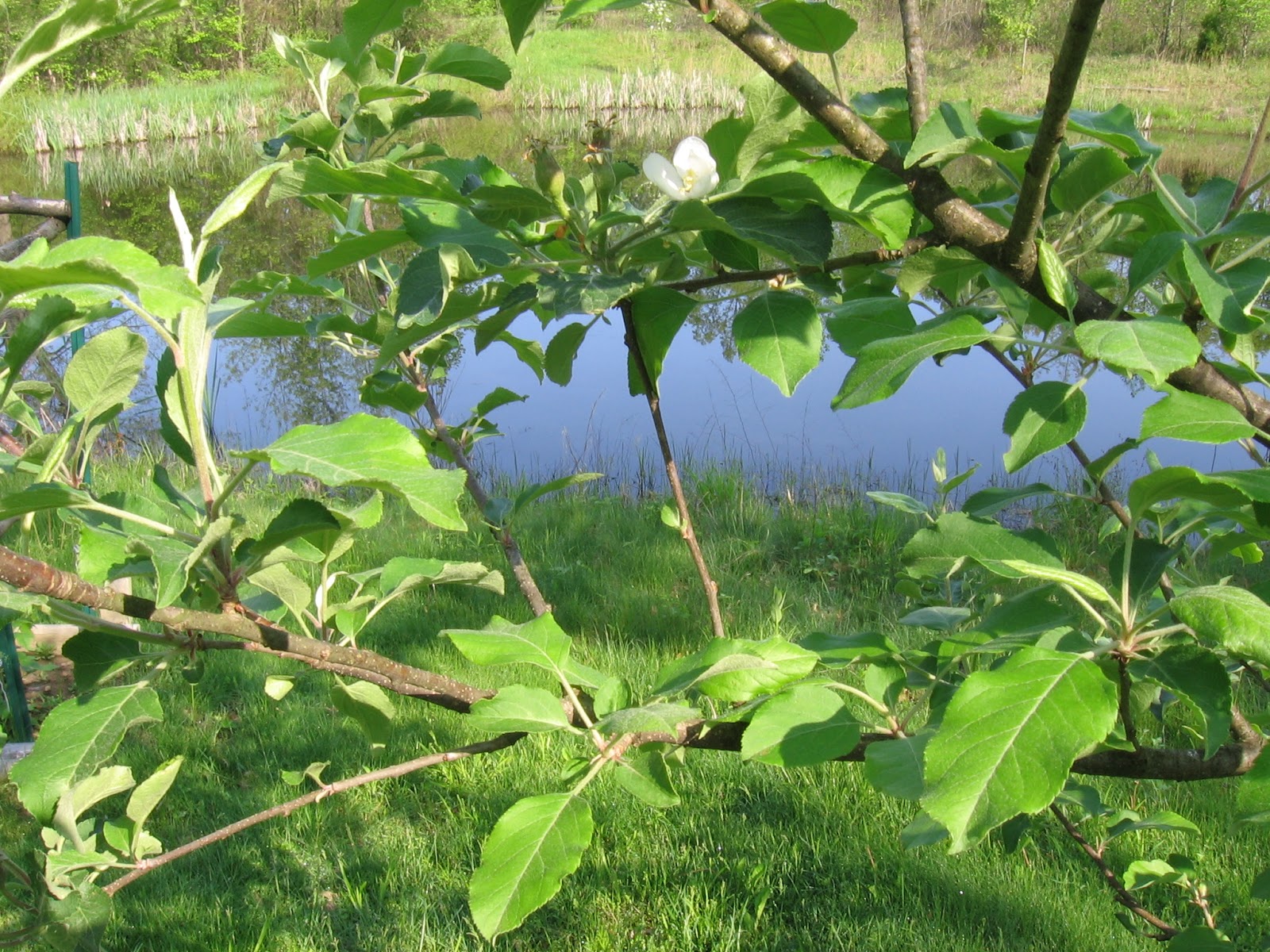
The apple trees had their first good bloom this year. I pruned them lightly this spring. Most of the flower buds, which are larger than the vegetative buds, were on the branch tips. Some were on the larger spurs which grow on older wood. I'm still trying to understand how to prune apple trees. About half of the branches were cut back from their tips.
One wrong assumption that I had made was that a flower bud terminates the growth of the branch. It does not, the branch will continue growing past the flowers, meaning the fruits will no longer be at the tips as the tips move past them. It makes sense, because nearly all the branches had flower buds at their tips before pruning, and how would the branches get bigger if the fruits terminated their growth?
Trees are classified as spur bearers or tip bearers, although most are a combination of both. The Fuji and Golden Delicious appear to bear predominantly from buds at the tips. This is a spur, probably two years old, with fruit and a lone flower:
I don't know if there are too many young apples for the trees to support. If there are too many the apples will be smallish, but that is an acceptable outcome. There may be some fruit drop as they mature. I'm not going to attempt to thin them. For me it's a learning process.
Tuesday, April 26, 2016
April 26 update
This year the warm weather is ahead of schedule. Many days in April have been more like summer than spring, and the trees are leafing out about two weeks earlier than normal. In my small plot I have been playing catch-up now that the main work of remodeling the kitchen is finished. In fact I'm a little surprised that things are doing as well as they are. It helps that I've been doing this for a few years now, and while methods are still evolving much of the work is like 'falling off a log.'
So here's a quick tour. First there's the big bed, the bed that grows squash, sweet potatoes and potatoes. The potatoes were planted a week ago, where the bare soil is, and the sprouts should appear any day now. The remainder of the bed was seeded with a cover crop of oats and inoculated field peas, which have really taken off. I've pulled up of a few of the pea plants and checked the roots. They are covered with root nodules, which shelter nitrogen-fixing bacteria.
The cover crop is growing like crazy. Every morning and evening I take the snips to it and cut off enough to fill a container for the rabbits. The doe had a litter of kits a week ago and a big appetite. Both the buck and doe are completely crazy for this, especially the peas. The doe jumps at the greens as they are tossed into her pen and nearly bites my hand. So the cover crop has worked out well, adding nitrogen to the soil and providing a food source for the bunnies. At the rate it grows I think it could support another doe and her litter.
The front bed in the next picture grew the overwintered spinach. For some reason the spinach is not so good this year, but once the outer leaves are discarded there is still some good spinach to be had. This bed will be planted with summer squash, eggplant and okra in few weeks. There are some really nice dill plants that self-seeded and I'll have to be careful not to harm them when the summer crops are planted.
The second bed has been planted with onions, carrots, beets and parsnip. There is still room for a few more rows of beets and carrots. The third bed will get tomatoes and peppers. Some field peas planted last year survived the winter and I'm happy to let them grow and add nitrogen to the soil. The bed in the back is a perennial bed, with asparagus, strawberries and herbs.
There are two beds for cole crops. Cutworms have been a problem, killing two broccoli plants in the same spot and damaging other plants. I sprayed the stems and surrounding soil with Bt and that seems to have stopped them.
Anise fennel is growing in a homemade SWC. The first time I tried growing fennel in a SWC I tried to grow eight in a single container and the results were disappointing. This time the container gets four plants.
The mobile cold frame has lettuce growing in an Earthbox. I'm sold on container-grown lettuce. It grows really well and stays clean. Pepper seedlings and brassica seedlings are growing in the trays. Most of the pepper seedlings were purchased at the local greenhouse and repotted to larger pots. It really looks like there will be no more frosts this spring, but if there is a mild frost the cold frame will hold temperature well enough to stay above freezing. A hard freeze and the peppers go inside.
Tomato, okra, eggplant and cucumber seedlings are growing inside under the lights. With one light unit and the cold frame there is just enough space to grow everything.
Lastly there's the raspberry bed, flanked by the apple trees. Both the Golden Delicious and the Fuji tree produced a lot more flowers than last year. Most of the flowers have dropped now. Looks like there may more than two apples this year.
That's the walkabout folks. Hope whatever you are growing is doing well.
Monday, April 18, 2016
First asparagus
Today I harvested the first asparagus spears. The roots were planted in 2014. Last year the first spears appeared on April 8. Nothing was picked last year, their first full year. With the mild winter I expected the first spears to show up earlier than last year. Maybe it was the cold spell in April, but the asparagus showed up later this year. At any rate they are here, and I can't wait to try them this evening.
There's been a lot of work to do in the garden this week. Two of the raised beds were tilled up for planting. I was pleasantly surprised by the tilth of the soil. All I had to do was break up the soil with a hoe, remove the weeds and rake it smooth. In years past it was necessary to spade over the beds then break up the clay clods with a power cultivator. It looks like the organic content of the soil is finally sufficient to prevent the clay from 'clotting' up.
I prepped the two beds in the center of the picture. With temperatures near 80 F, the soil surface of one bed was already dried after the second bed was prepped.
In the cold frame were about sixty-five Ruby Ring onion seedlings and some brassica seedlings, ready for planting. Right now there's just enough space in the cold frame and under the indoor lights to hold all the seedlings, as I move the larger seedlings into the cold frame to make room for planting more seeds.
The lettuce is producing a regular supply of greens now. Soon I'll need to start another SWC.
After a hiatus last year parsnip is back in the planting schedule. I seeded a 4x4 section in parsnip.
The first set of brassicas was lost to a triple whammy of storms, mole damage, and finally rabbits, which administered the coup de grace. So I built a frame to go over the raised bed to protect the new cole crops. Chicken wire is on the sides and Agribon row cover was stapled over the top. Should keep the bunnies out.
Today the large bed got the treatment. It's got a pretty good cover of oats and field peas growing on it. Most of this bed will be planted in squash and sweet potatoes, but that's nearly a month away.
About a third of this bed was spaded over and cultivated for potatoes, two rows of Red Pontiacs and one row of Kennebecs.
To see what other people are growing head on over to http://www.ourhappyacres.com/
Tuesday, April 12, 2016
Functional. Not finished
This is a big week for me. After over six months of work the kitchen remodel has birthed a fully functioning kitchen. With a sink, running water, a dishwasher that cleans dishes all by itself, in other words it actually works. No more washing dishes in the bathtub, and eating deli potato salad and grilled chicken. This is the recently completed section.
The sink is what I like the best. It's a granite composite sink that has different sized bowls. The large basin is large enough hold a frying pan, something the old sink could not do.
The drain hookups were a pain since the drain line is directly behind the disposal. You'd think that Swan would offer a mirror image of this sink but no. Fortunately everything fitted. I'm installing an undersink filter on the cold water line, just have to get some fittings and lines. The house is supplied by well water which should be clean, but why not have something to remove any organic compounds that find their way into the aquifer?
Here's a look at most of the kitchen, showing the floor tiles. It's an odd floor plan, with the traffic from the front entry going straight through the kitchen then into the rest of the house. Nothing I can do about that, but the new layout is way more functional and efficient compared to the old one. The hallway still needs work.
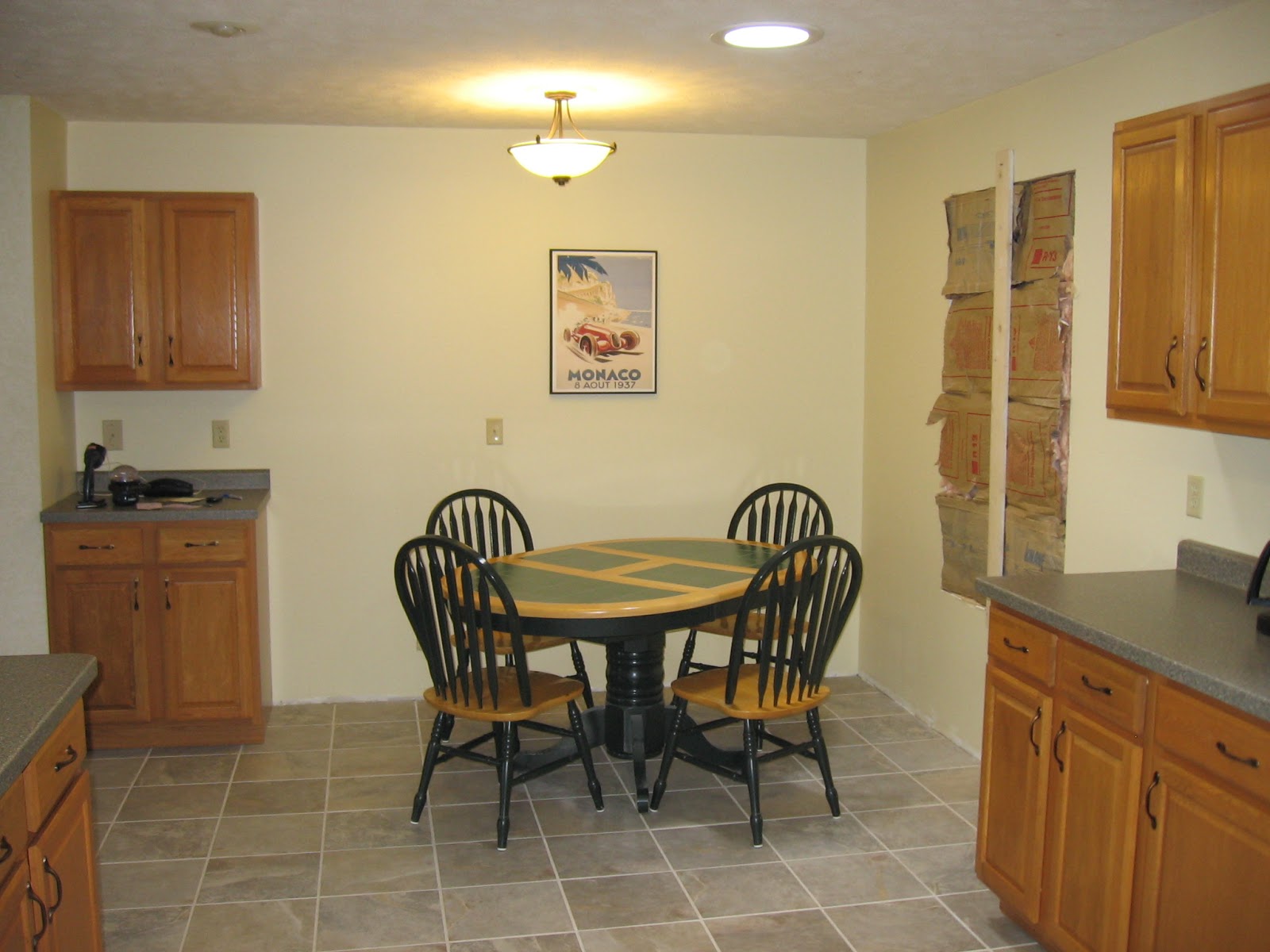
The new kitchen has space for dining, sort of a nook. The old layout had no real place to put a table. The window isn't in yet. Later this week I hope to install the window, now that the weather is getting better.
The kitchen is functional but certainly not finished. In addition to the window, there is baseboard and casing to install. The doors in the hallway have to be cut down so they can clear the tile floor, the top of the wall cabinets will get a shelf and some sort of molding, and I have to fabricate new thresholds for the doors in the hallway. At least there is no urgency to do this, not the kind that one has when a kitchen has no running water.
Subscribe to:
Posts (Atom)