A bit more this week. Garlic is out and drying in the pole barn. In its place I seeded another Green Tiger summer squash. I still haven't gotten the first summer squash from the plant that was seeded in May. Most summer squash don't last the season, and I like to plant a new one every month or so.
Late last week I harvested more cucumbers, both picklers and a slicer, the first eggplant and a few okra.
Still no beans, as the rabbits leveled the first seeding. They have been a real problem this year, and are still nibbling on the beans in spite of Neem oil sprays. Since they also got the lettuce in the Earthbox, I raised the stand about a foot and a half above ground level. Then I seeded okra at each end of the Earthbox. It's Jambalya, a smallish okra that should do well in a container. Now let's see them reach that.
The last of the cabbage was picked over the weekend, Point One and Gonzalez. Also a small head of broccoli. I had my first success with making sauerkraut and I'll make another batch from this cabbage. Until this my fermenting attempts have always failed, even after adding starter culture. This time I added some yogurt water and the cabbage started bubbling the first day. It's delicious, very sour with a fresh cabbage taste. I never knew what I was missing.
To see what other people are getting from their gardens, head on over to Our Happy Acres.
Growing vegetables in raised beds. Wildlife habitat. Building things. Location: SW Indiana.
Pages
Monday, July 2, 2018
Monday, June 25, 2018
Cucumbers
Most of the summer crops are still in a holding pattern, but I did get cucumbers. Last week I picked enough Vertina picklers to make a jar of refrigerator pickles. There's enough volunteer dill in the beds, maybe too much, to make lots of pickles as long as the vines stay healthy. I used fresh dill, including the flower, dill seeds, mustard seeds, coriander and peppercorns in a 50/50 mix of Bragg's vinegar and water, with some salt. Refrigerator pickles are quick and easy, and they are always good and crunchy.
Later in the week I picked the first slicing cucumber, Swing. This is the first time I've grown it, having grown Diva for years. Like Diva, it's an all female cucumber, very robust and disease resistant. It's got good flavor too, a winner for sure. There happened to be a bottle of beer nearby and I set it next to the cuke for a size comparison.
Not shown are two small heads of Gonzalez cabbage, which were shredded for sauerkraut. It's been bubbling away for almost a week and appears to be about ready. This may be my first successful fermentation, keeping my fingers crossed. To see what other people are growing, head on over to Our Happy Acres and check it out.
Later in the week I picked the first slicing cucumber, Swing. This is the first time I've grown it, having grown Diva for years. Like Diva, it's an all female cucumber, very robust and disease resistant. It's got good flavor too, a winner for sure. There happened to be a bottle of beer nearby and I set it next to the cuke for a size comparison.
Not shown are two small heads of Gonzalez cabbage, which were shredded for sauerkraut. It's been bubbling away for almost a week and appears to be about ready. This may be my first successful fermentation, keeping my fingers crossed. To see what other people are growing, head on over to Our Happy Acres and check it out.
Saturday, June 23, 2018
Emerald ash borer
There are a lot of ash trees on my property and I've always been concerned that the emerald ash borer would reach this area. A few years ago I read that it was identified in Morgan-Monroe state forest, about 25 miles from here. I had hoped that it would take it a while to make the jump over farmland to this area, which is about 50% forested. Maybe I just haven't noticed the damage, but recently it became very evident. It's here.
There are two kinds of ash trees around my house. A large white ash tree grows between the house and the pond. The rest of the ash trees are green ash, a smaller ash tree that is definitely another species (I compared the leaves and twigs a few years ago and there are, even to my eye, obvious differences). To me, the green ash is the perfect yard tree, nice shape, not messy, and it doesn't get as large as the white ash. This one, about 40 feet tall, is in the driveway circle.
These trees are also in a buffer area between the yard and the woods, an area that I mow with a brush cutter about once a month. Four of the five trees are green ash. There are several more small to medium ash trees growing at the edge of the woods.
Three of these trees look fairly healthy, although I have no doubt that they have already been infested. One of the trees is near its end. The crown is nearly barren, there is woodpecker damage to the bark everywhere, and the base of the tree is sending up shoots because its vascular system is too damaged to move nutrients higher in the tree.
A closer look shows the bark stripped off by woodpeckers trying to get at the borers, and the telltale D-shaped exit hole where the adult beetle emerges from the tree.
Yesterday I cut down a green ash that was a few feet in the woods. It took all day to fell it, carefully remove the poison ivy from the trunk, remove the limbs, cut it up into logs, then split, move and stack the logs. On the positive side I got a face cord of wood from one tree, which I will burn this winter. The adults have already emerged from the trees and larva are actively feeding in the phloem at this time, so cutting the trees should kill most of the larva. I expect to cut several more trees in the coming week, including the one in the photo above.
The tree that really worries me is the large white ash behind the house. It's over two feet in diameter and felling it is beyond my capabilities, so I'm looking at some expense here. Still it looks healthy so far. It's thicker bark may slow the beetles somewhat. I've read that treatments are effective but a tree must be re-treated every year. I'm leaning more toward removal, since there is a very nice black gum tree just a few feet from this ash, which is on the left in this picture. Before this tree can be dropped, I will have to remove the raised bed frames. A winter job for sure.
It's a shame this had to happen, but it's something that looked inevitable, a matter of when not if. The woodlot has a number of American elms growing in it. They get large enough to reproduce, but never survive to any size, another iconic tree, along with the chestnut, that's been mostly lost to an imported biological agent. Asian ashes have evolved mechanisms to fight off the borer, and one can only hope that a few resistant trees will survive and reproduce here.
There are two kinds of ash trees around my house. A large white ash tree grows between the house and the pond. The rest of the ash trees are green ash, a smaller ash tree that is definitely another species (I compared the leaves and twigs a few years ago and there are, even to my eye, obvious differences). To me, the green ash is the perfect yard tree, nice shape, not messy, and it doesn't get as large as the white ash. This one, about 40 feet tall, is in the driveway circle.
These trees are also in a buffer area between the yard and the woods, an area that I mow with a brush cutter about once a month. Four of the five trees are green ash. There are several more small to medium ash trees growing at the edge of the woods.
Three of these trees look fairly healthy, although I have no doubt that they have already been infested. One of the trees is near its end. The crown is nearly barren, there is woodpecker damage to the bark everywhere, and the base of the tree is sending up shoots because its vascular system is too damaged to move nutrients higher in the tree.
A closer look shows the bark stripped off by woodpeckers trying to get at the borers, and the telltale D-shaped exit hole where the adult beetle emerges from the tree.
Yesterday I cut down a green ash that was a few feet in the woods. It took all day to fell it, carefully remove the poison ivy from the trunk, remove the limbs, cut it up into logs, then split, move and stack the logs. On the positive side I got a face cord of wood from one tree, which I will burn this winter. The adults have already emerged from the trees and larva are actively feeding in the phloem at this time, so cutting the trees should kill most of the larva. I expect to cut several more trees in the coming week, including the one in the photo above.
The tree that really worries me is the large white ash behind the house. It's over two feet in diameter and felling it is beyond my capabilities, so I'm looking at some expense here. Still it looks healthy so far. It's thicker bark may slow the beetles somewhat. I've read that treatments are effective but a tree must be re-treated every year. I'm leaning more toward removal, since there is a very nice black gum tree just a few feet from this ash, which is on the left in this picture. Before this tree can be dropped, I will have to remove the raised bed frames. A winter job for sure.
It's a shame this had to happen, but it's something that looked inevitable, a matter of when not if. The woodlot has a number of American elms growing in it. They get large enough to reproduce, but never survive to any size, another iconic tree, along with the chestnut, that's been mostly lost to an imported biological agent. Asian ashes have evolved mechanisms to fight off the borer, and one can only hope that a few resistant trees will survive and reproduce here.
Monday, June 18, 2018
Monday June 18
It seems like this area went from winter to summer without stopping for spring. Yesterday I was reading an article in the Bloomington paper that noted that April was the 3rd coldest April on record while May was the hottest May on record. That's quite an abrupt transition. It's been a real heat wave for several days. I took this picture at sunset on Saturday evening, while it was still nearly 90 degrees. The sky was mostly cloudless but this one cloud boiled up like a storm cloud. Nothing ever came of it.
The weather has had it's effect on the vegetable garden for sure. I usually begin harvesting cole crops in May, but this year I picked the first cabbage a week ago. The cutworms did not help in that regard. Yesterday I picked the first broccoli and kohlrabi. The kohlrabi should have been picked earlier.
At least the summer crops are moving right along. This slicing cucumber should be ready in a few days, and it looks like enough pickling cucumbers will be ready shortly to make a quart of refrigerator pickles.
An unidentified bug has been attacking the cucumbers and causing the growing tips to turn brown. Fortunately the plants are healthy enough to start new vines and I'm hoping the bugs can be kept under control. The first Japanese beetles appeared yesterday. I was hoping that the hard winter had killed most of them, but they seem to be abundant.
The tomatoes are looking good, with no sign of disease to this point. I planted two determinate sauce tomatoes - Health Kick and Plum Regal. I didn't think a tomato could be more vigorous than Plum Regal but Health Kick is actually setting more tomatoes.
To see what other growers are harvesting, head on over to http://www.ourhappyacres.com/and have a look.
The weather has had it's effect on the vegetable garden for sure. I usually begin harvesting cole crops in May, but this year I picked the first cabbage a week ago. The cutworms did not help in that regard. Yesterday I picked the first broccoli and kohlrabi. The kohlrabi should have been picked earlier.
At least the summer crops are moving right along. This slicing cucumber should be ready in a few days, and it looks like enough pickling cucumbers will be ready shortly to make a quart of refrigerator pickles.
An unidentified bug has been attacking the cucumbers and causing the growing tips to turn brown. Fortunately the plants are healthy enough to start new vines and I'm hoping the bugs can be kept under control. The first Japanese beetles appeared yesterday. I was hoping that the hard winter had killed most of them, but they seem to be abundant.
The tomatoes are looking good, with no sign of disease to this point. I planted two determinate sauce tomatoes - Health Kick and Plum Regal. I didn't think a tomato could be more vigorous than Plum Regal but Health Kick is actually setting more tomatoes.
To see what other growers are harvesting, head on over to http://www.ourhappyacres.com/and have a look.
Saturday, June 9, 2018
Pest control and prevention
Early in the growing season, it's critical to establish some sort of spraying program to control insects and fungal infestations. Cultural methods for protection - rotation, removal of debris, pruning - are also critical and something that is done year 'round, but that is for another post. Here are the chemicals that I use that I consider safe when used properly and get the job done.
Thuricide, or Bt, is a bacterium that targets caterpillars only. I've found it to be the best control of the cabbage worm. I also spray it on the stems of squash plants to prevent the vine borer, which is a moth. Once a caterpillar comes into contact with Bt it stops feeding and dies within a day or two. The cabbage worms had already done some damage to the cole crops by the time I sprayed them with Bt, but I haven't seen any further damage. I just try to avoid using it on a brassica shortly before harvest.
The first sets of brassicas that I planted were mowed down by the cutworms. That's another control that I will have to develop next year. I've read that Bt sprayed on corn flakes around the base of the plants will stop them but haven't tried that yet.
Last year my two apple trees were beset by some sort of scale and aphids at the same time. I found that a combination of insecticidal soap and Neem extract was very effective in killing them, or any small soft-bodied insect such as thrips. I use 2.5 oz of soap and 1 oz of Neem per gallon of water, first adding the soap since it helps disperse the oil. The soap kills by dessicating, or sucking the water out of the insect, while the Neem disrupts cell membranes. It may not kill a full grown squash bug but it will make them come to the top of the leaf where they can be picked off. As an added bonus, I've found that Neem is effective in controlling powdery mildew on squash.
I noticed that a commercial maker of pesticides is using the same combination, with added pyrethrins, as an organic insecticide. I tried adding some pyrethrins to the first mix that I prepared and can say that it is deadly to flea beetles, but the pyrethrins may not have been necessary. It's important to avoid pyrethrins in the morning when bees are about. I also used this combination on the cucumber vines which were under attack by a bug that looks like a squash bug but has a harder shell (bugs are actually an insect family that has mouthparts that penetrate a leaf and suck the juices from the plant). It killed the bugs but I'm concerned that they may have already transferred a fungus or bacterium into the plants. The growing tips look bad.
The newest addition for fungal control is Liqui-Cop, for liquid copper. This is basically copper in a chemical form that is soluble in water, specifically copper diammonia diacetate complex, which sounds more exotic than it is. An alternative soluble copper is copper octanoate, or copper soap, which is found at Lowe's. I went with the Liqui-Cop, which I bought online, because it appears to be more effective. It's easy to mix and use. At a copper equivalent of 8%, the amount of copper in a gallon of mix at 4 teaspoons per gallon is actually very small.
The Liqui-Cop is mainly for the tomatoes, where it is supposed to be effective against bacterial spot, bacterial speck, early blight and late blight. As a preventive I have been spraying the tomatoes weekly, as well as the cucumbers, raspberries, and potatoes. So far the tomatoes look good, about 4 feet tall, but it's really too early to tell if it works.
One pesticide not shown is a deer and rabbit repellent. The bunnies have been a real problem this year. They ate most of the bean seedlings, some of the carrots, then got into the Earthbox and ate the lettuce. I reseeded the beans and once up, applied the repellent. The first ingredient is putrefied egg whites, and it smells kind of bad. It seems to work though and may keep them off the beans until they are big enough to be unpalatable.
Thuricide, or Bt, is a bacterium that targets caterpillars only. I've found it to be the best control of the cabbage worm. I also spray it on the stems of squash plants to prevent the vine borer, which is a moth. Once a caterpillar comes into contact with Bt it stops feeding and dies within a day or two. The cabbage worms had already done some damage to the cole crops by the time I sprayed them with Bt, but I haven't seen any further damage. I just try to avoid using it on a brassica shortly before harvest.
The first sets of brassicas that I planted were mowed down by the cutworms. That's another control that I will have to develop next year. I've read that Bt sprayed on corn flakes around the base of the plants will stop them but haven't tried that yet.
Last year my two apple trees were beset by some sort of scale and aphids at the same time. I found that a combination of insecticidal soap and Neem extract was very effective in killing them, or any small soft-bodied insect such as thrips. I use 2.5 oz of soap and 1 oz of Neem per gallon of water, first adding the soap since it helps disperse the oil. The soap kills by dessicating, or sucking the water out of the insect, while the Neem disrupts cell membranes. It may not kill a full grown squash bug but it will make them come to the top of the leaf where they can be picked off. As an added bonus, I've found that Neem is effective in controlling powdery mildew on squash.
I noticed that a commercial maker of pesticides is using the same combination, with added pyrethrins, as an organic insecticide. I tried adding some pyrethrins to the first mix that I prepared and can say that it is deadly to flea beetles, but the pyrethrins may not have been necessary. It's important to avoid pyrethrins in the morning when bees are about. I also used this combination on the cucumber vines which were under attack by a bug that looks like a squash bug but has a harder shell (bugs are actually an insect family that has mouthparts that penetrate a leaf and suck the juices from the plant). It killed the bugs but I'm concerned that they may have already transferred a fungus or bacterium into the plants. The growing tips look bad.
The newest addition for fungal control is Liqui-Cop, for liquid copper. This is basically copper in a chemical form that is soluble in water, specifically copper diammonia diacetate complex, which sounds more exotic than it is. An alternative soluble copper is copper octanoate, or copper soap, which is found at Lowe's. I went with the Liqui-Cop, which I bought online, because it appears to be more effective. It's easy to mix and use. At a copper equivalent of 8%, the amount of copper in a gallon of mix at 4 teaspoons per gallon is actually very small.
The Liqui-Cop is mainly for the tomatoes, where it is supposed to be effective against bacterial spot, bacterial speck, early blight and late blight. As a preventive I have been spraying the tomatoes weekly, as well as the cucumbers, raspberries, and potatoes. So far the tomatoes look good, about 4 feet tall, but it's really too early to tell if it works.
One pesticide not shown is a deer and rabbit repellent. The bunnies have been a real problem this year. They ate most of the bean seedlings, some of the carrots, then got into the Earthbox and ate the lettuce. I reseeded the beans and once up, applied the repellent. The first ingredient is putrefied egg whites, and it smells kind of bad. It seems to work though and may keep them off the beans until they are big enough to be unpalatable.
Wednesday, May 16, 2018
New developments
Well, it's official. I bought the property adjacent to mine. The guy who wanted to put in three trailers on the lot put it up for sale after losing his petition for a zoning variance. I felt I had to do something to protect my pond, since a part of the pond lies in the adjoining lot. If a new owner was to graze horses or cattle close to the pond, or even worse, allow animals to access the pond, it would be infested with slimy algae. The yellow tape marks the old property line.
Now I'm waiting on a survey to divide the property. I'm keeping only a hundred feet swath that adjoins my property while my neighbor on the other side of the lot will buy the remainder from me. I am in the process of clearing the corner so I can put in some more garden and also some fruit trees. The garden will grow squash and sweet corn. I'll buy a gas powered pump for watering. Once this area is cleared I'll lay down a sheet mulch to get it ready for next year.
The lot has been in the procession of succession from pasture to woods since I moved here ten years ago. It's probably about 3/4 tulip poplar, with some oak, maple, cherry, walnut and other more desirable trees making up the remainder. I plan to selectively remove many of the tulip poplar, which is almost a weed in my view, to make room for the other trees.
It's hard to believe that the garden is mostly in. It's hard to remember if we even had a spring, and it's certainly summer now. About a week ago I dug up the two beds that get solanacae. The beds had a cover crop of oats and field peas that was seeded in March. The ground was nice and loamy, easy to turn over.
The roots of the field peas were covered with nodules containing nitrogen-fixing bacteria.
After turning over with a shovel the beds were tilled with the little mini-cultivator. I hope the day comes when this isn't necessary, but there are still some clods of clay in the soil that need breaking up. The tomato cages were installed on fence posts and the tomato seedlings were set in, along with peppers and eggplant. Fast forward to now, and they are looking pretty good.
While the indeterminate tomatoes are grown in narrow 16 inch cages that are 5 feet tall, actually taller because they are hung on the fence posts a foot above the ground, the determinate sauce tomatoes are grown in wide 22 inch cages that are 4 feet tall. The unplanted spaces will get Bride eggplant, which germinated a week later than the other eggplant and isn't quite ready to be put into the bed.
After losing most of the brassicas to cutworms, the last set of seedlings escaped their onslaught. Maybe the repeated sprays of Bt got the little devils. Better late than never. Since the remainder of this bed will not get brassicas, I seeded bush beans and carrots in the open space.
Cucumbers were set out. There's one Swing cucumber, a new one for me, for slicing, and four pickling cucumbers, Calypso and Vertina. The cutworms got many of the onions as well but they have recovered much better than the cole crops.
The big bed also had a cover of oats and peas. I tilled up small patches and seeded squash in each patch. There's a pole bean trellis in back. The squash should have no problem growing over the top of the cover crop, which will wilt in the summer's heat.
While I was finishing up the garden work last weekend, the neighbor's son stopped by and did some fishing. He got several nice bass.
The robins made a nest in the strawberry planter, and every time I walk out to the garden she flies off in a commotion. Guess we will have to co-exist.
And the front of the house is still a work in progress, with new edging around the flower beds waiting on when I get the time. I had hoped to have this finished last fall, then broke my foot. I was amazed that all the plants returned after the trampling some of them got while the porch was being rebuilt. The rhododendron, which has never looked healthy, will be removed, after it has flowered of course, and replaced with a shade-tolerant hydrangea. As a final touch I'm refinishing the cedar rocking chair which will take its rightful place on the porch.
Now I'm waiting on a survey to divide the property. I'm keeping only a hundred feet swath that adjoins my property while my neighbor on the other side of the lot will buy the remainder from me. I am in the process of clearing the corner so I can put in some more garden and also some fruit trees. The garden will grow squash and sweet corn. I'll buy a gas powered pump for watering. Once this area is cleared I'll lay down a sheet mulch to get it ready for next year.
The lot has been in the procession of succession from pasture to woods since I moved here ten years ago. It's probably about 3/4 tulip poplar, with some oak, maple, cherry, walnut and other more desirable trees making up the remainder. I plan to selectively remove many of the tulip poplar, which is almost a weed in my view, to make room for the other trees.
It's hard to believe that the garden is mostly in. It's hard to remember if we even had a spring, and it's certainly summer now. About a week ago I dug up the two beds that get solanacae. The beds had a cover crop of oats and field peas that was seeded in March. The ground was nice and loamy, easy to turn over.
The roots of the field peas were covered with nodules containing nitrogen-fixing bacteria.
After turning over with a shovel the beds were tilled with the little mini-cultivator. I hope the day comes when this isn't necessary, but there are still some clods of clay in the soil that need breaking up. The tomato cages were installed on fence posts and the tomato seedlings were set in, along with peppers and eggplant. Fast forward to now, and they are looking pretty good.
While the indeterminate tomatoes are grown in narrow 16 inch cages that are 5 feet tall, actually taller because they are hung on the fence posts a foot above the ground, the determinate sauce tomatoes are grown in wide 22 inch cages that are 4 feet tall. The unplanted spaces will get Bride eggplant, which germinated a week later than the other eggplant and isn't quite ready to be put into the bed.
After losing most of the brassicas to cutworms, the last set of seedlings escaped their onslaught. Maybe the repeated sprays of Bt got the little devils. Better late than never. Since the remainder of this bed will not get brassicas, I seeded bush beans and carrots in the open space.
Cucumbers were set out. There's one Swing cucumber, a new one for me, for slicing, and four pickling cucumbers, Calypso and Vertina. The cutworms got many of the onions as well but they have recovered much better than the cole crops.
The big bed also had a cover of oats and peas. I tilled up small patches and seeded squash in each patch. There's a pole bean trellis in back. The squash should have no problem growing over the top of the cover crop, which will wilt in the summer's heat.
While I was finishing up the garden work last weekend, the neighbor's son stopped by and did some fishing. He got several nice bass.
The robins made a nest in the strawberry planter, and every time I walk out to the garden she flies off in a commotion. Guess we will have to co-exist.
And the front of the house is still a work in progress, with new edging around the flower beds waiting on when I get the time. I had hoped to have this finished last fall, then broke my foot. I was amazed that all the plants returned after the trampling some of them got while the porch was being rebuilt. The rhododendron, which has never looked healthy, will be removed, after it has flowered of course, and replaced with a shade-tolerant hydrangea. As a final touch I'm refinishing the cedar rocking chair which will take its rightful place on the porch.
Thursday, May 3, 2018
Mid-spring update, May 3
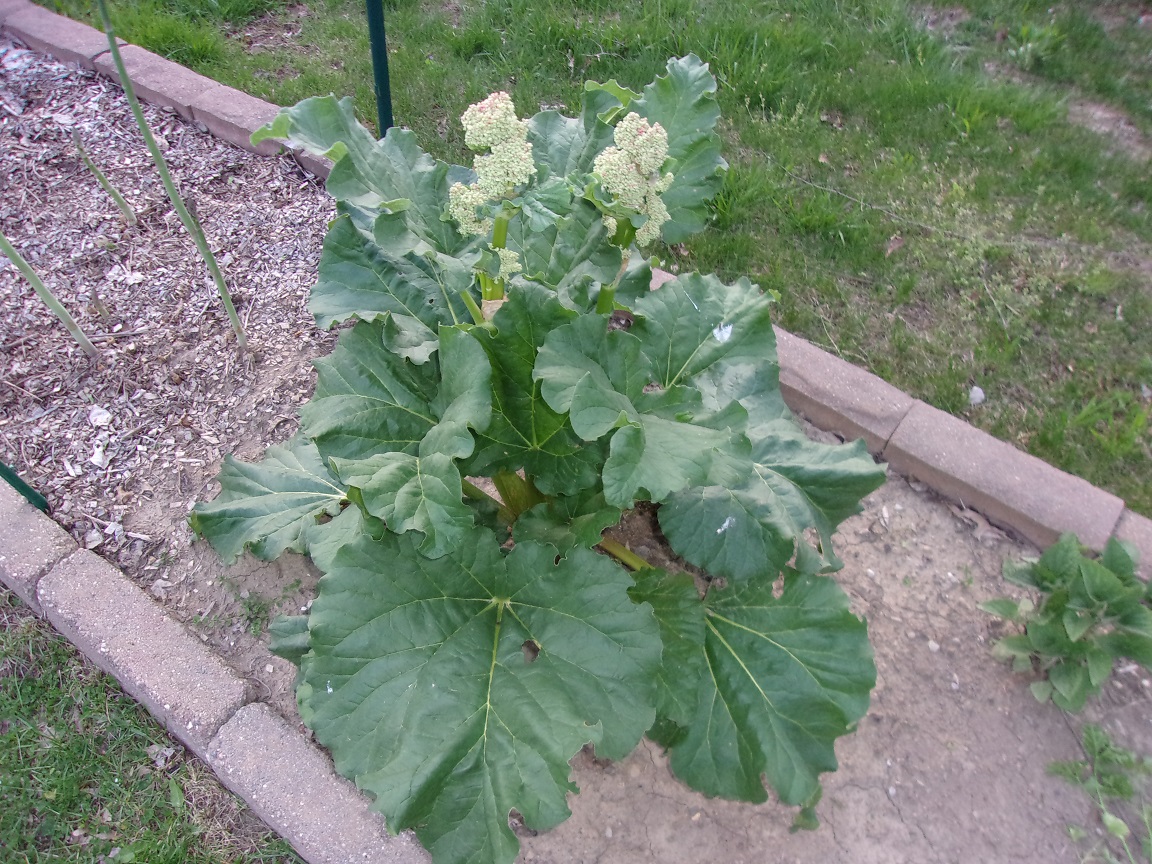
Yesterday's weather was mid-80's in the afternoon, with little shade because the trees hadn't leafed out. I think yesterday's warm weather jumped started the leaves, because they are unfurling at a rapid pace now, and things are moving along at a good pace in the vegetable garden too. The rhubarb, planted last year, is sizing up nicely. I know that you are supposed to cut off the flowers but I want to see what they look like.
These asparagus shoots, over a foot tall, got away from me. Still, only a few inches at the bottom was woody. Four of the six plants are producing now, and I'm waiting on shoots from the other two. Hope they did not die over the winter.
Moved out of the coldframe over a week ago, the Earthbox lettuce is practically popping out of the container. I plant the lettuce thick, so when one plant is cut a neighbor quickly takes its place. The lettuce this year is growing in ProMix, so much better than the lettuce that did not even grow last year in a name brand potting mix which shall not be named. I need to do another picking to make room for some summer lettuce (Pinetree's year-round mix).
With nothing even close to a frost in the forecast, the tomatoes were moved out to the coldframe to join the peppers. With abundant natural light they are really growing strong, and should be more than ready for planting in about a week.
Under the LED lights, a few of the tomato plants were starting to show signs of leaf burn as they grew taller and closer to the lights. As with the lettuce, I think this is a problem with the two UV LED's in each unit. Since the individual reflectors do not spread the light out very much, a seedling that grows directly under a UV LED could get too much of this high energy light. It's not that much damage, and the plants have easily outgrown the damage now that they are outdoors, but still, it's a concern and a fundamental flaw in the design.
Under the lights, okra, eggplant, cucumber and one Basil plant remain, as well as some flower seeds that haven't germinated yet. The Bride eggplant took nearly ten days longer to germinate than the Lavendar Touch eggplant, but it'll get there. The okra and cucumber look small, but they come on really fast, so they should be ready in less than two weeks.
Oh, the cutworms ravaged the cole crops once again, after I had planted a new set of them to replace the previous plants lost to the cutworms. They spared most of the cabbage, seeming to prefer broccoli and kohlrabi. I guess they win this round, but I'd like to think that the leaves sprayed with Bt did a number on them. There's one more set of cole crops in the coldframe which will be ready for planting in about a week, and I'm still hoping that one or two broccoli plants survive.
Next year will require more drastic measures.
These asparagus shoots, over a foot tall, got away from me. Still, only a few inches at the bottom was woody. Four of the six plants are producing now, and I'm waiting on shoots from the other two. Hope they did not die over the winter.
Moved out of the coldframe over a week ago, the Earthbox lettuce is practically popping out of the container. I plant the lettuce thick, so when one plant is cut a neighbor quickly takes its place. The lettuce this year is growing in ProMix, so much better than the lettuce that did not even grow last year in a name brand potting mix which shall not be named. I need to do another picking to make room for some summer lettuce (Pinetree's year-round mix).
With nothing even close to a frost in the forecast, the tomatoes were moved out to the coldframe to join the peppers. With abundant natural light they are really growing strong, and should be more than ready for planting in about a week.
Under the LED lights, a few of the tomato plants were starting to show signs of leaf burn as they grew taller and closer to the lights. As with the lettuce, I think this is a problem with the two UV LED's in each unit. Since the individual reflectors do not spread the light out very much, a seedling that grows directly under a UV LED could get too much of this high energy light. It's not that much damage, and the plants have easily outgrown the damage now that they are outdoors, but still, it's a concern and a fundamental flaw in the design.
Under the lights, okra, eggplant, cucumber and one Basil plant remain, as well as some flower seeds that haven't germinated yet. The Bride eggplant took nearly ten days longer to germinate than the Lavendar Touch eggplant, but it'll get there. The okra and cucumber look small, but they come on really fast, so they should be ready in less than two weeks.
Oh, the cutworms ravaged the cole crops once again, after I had planted a new set of them to replace the previous plants lost to the cutworms. They spared most of the cabbage, seeming to prefer broccoli and kohlrabi. I guess they win this round, but I'd like to think that the leaves sprayed with Bt did a number on them. There's one more set of cole crops in the coldframe which will be ready for planting in about a week, and I'm still hoping that one or two broccoli plants survive.
Next year will require more drastic measures.
Subscribe to:
Posts (Atom)